The Builder's Playbook · 01 of 6
Test Before You Build
Stop guessing. Start proving. Validate your idea before writing a single line of code.
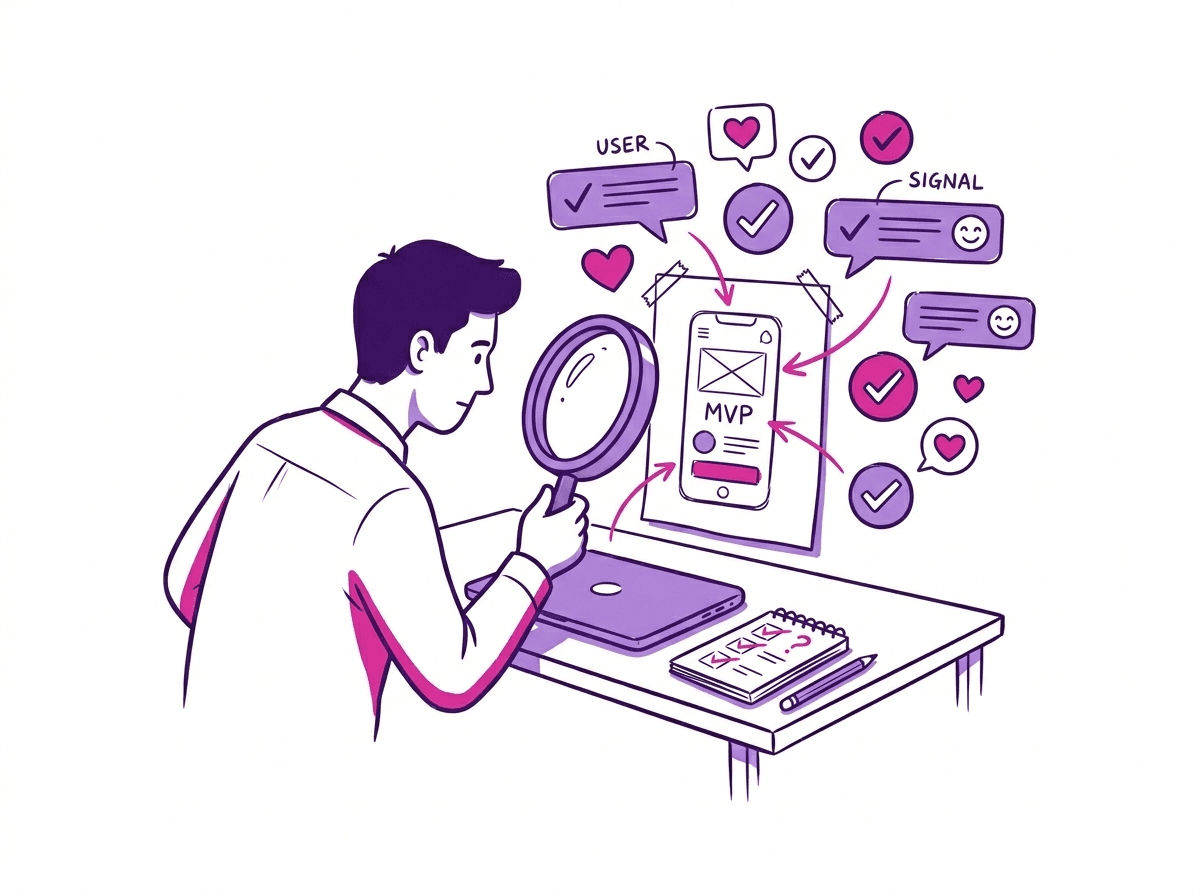
VALIDATE
Test Before You Build
CB Insights, 2024 — Top Reasons Startups Fail
You have an idea you’re excited about. Maybe you’ve already started wireframing. Maybe you’ve told everyone who’ll listen. But here’s the uncomfortable truth: excitement isn’t evidence.
Most founders skip validation because it feels slow. They’d rather be building. Six months later, they have a polished product and zero customers.
This playbook exists so that doesn’t happen to you. It gives you a proven system to test your idea in 8 weeks or less—using real conversations, real data, and real money as your evidence.
Everything you need to validate your idea in 30 days.
Why most founders skip validation (and pay for it later). The cognitive biases that kill startups. The Mom Test framework for asking questions that reveal truth.
The 10-person interview framework. Where to find interview targets. The exact 5 questions to ask. Interview scoring rubric with green, yellow, and red signals.
5 validation methods ranked by evidence quality: Landing Page Test, Fake Door Test, Concierge MVP, Wizard of Oz, and Smoke Test. Decision flowchart for choosing the right one.
The Credit Card Test. Pre-sale strategies with Gumroad and Stripe. The Van Westendorp pricing technique. Revenue milestone markers from first customer to $5K MRR.
Lean Canvas, Jobs-to-be-Done, Riskiest Assumption Test (RAT), and ACP Framework. A comparison table and guidance on how to stack frameworks for a complete validation picture.
The 5 signals you've validated enough. The 70% Rule. The Validation Decision Matrix: green light (build), yellow light (test more), red light (pivot or kill).
Step-by-step validation framework with actionable checklists, diagrams, and real-world examples you can follow in 8 weeks.
Pre-built workspace with idea hypothesis, interview tracker, solution test tracker, landing page metrics, and go/no-go decision checklist.
Quantitative framework to score your idea's viability across problem fit, solution fit, willingness to pay, and market size.
Proven scripts for problem interviews and customer discovery conversations. The exact questions to ask and signals to look for.
Template to map your competitive landscape, identify positioning gaps, and find your differentiation angle.
Frameworks, copy templates, and conversion benchmarks for testing demand before you build. Tools list included.
A pre-built Notion workspace with frameworks, trackers, and action items from every chapter — ready to use immediately.
Drew Houston didn't build Dropbox first. He made a 3-minute demo video showing what it would do and posted it on Hacker News.
Waitlist went from 5,000 to 75,000 overnight. No product needed.
Show, don't tell. A demo video proving your concept can validate demand faster than months of building.
Joel Gascoigne validated Buffer with a 2-page landing page. No product. Just screenshots, a description, and pricing.
100 beta signups and 50 people entered their credit card info before a single line of code was written.
Credit card signups beat email signups. Real pricing validation proves demand in a way surveys never can.
Brian Chesky and Joe Gebbia didn't build a platform first. They took photos of their apartment, listed it on Craigslist, and rented it out manually.
First customer paid $80/night. They repeated the process in multiple cities before building the platform.
Do the work manually first. Concierge MVPs prove demand with zero infrastructure investment.
Learn the exact framework used by Dropbox, Buffer, and Airbnb to prove demand before building. Includes the 10-person...
Annual members get all playbooks included in their plan.
Learn more30-day money-back guarantee. No questions asked.
Not every resource is for everyone. Here's a quick way to know if this playbook aligns with where you are right now.
Get more playbooks together and save. Each bundle includes instant access to every playbook listed.
For founders in the idea and early-build stage
Save $50
This playbook is included
For founders who have launched and are pushing for scale
Save $50

All 6 playbooks + combined Notion workspace
Save $127
This playbook is included
