Why it helps
A proposal should confirm a choice the client has already half made, not argue for one. If the call settled the problem, the outcome, how success will be measured and the rough budget, the proposal can be short. Short proposals are faster to write, faster to read and easier to approve. If the call did not settle those things, you need another talk, not a longer document.
Before you write
Check your call notes for these five facts:
- The problem, in the client's own words.
- The outcome they want, and how they will know they got it.
- The limits: timing, budget range, people, anything ruled out.
- Who decides, and who else will read it.
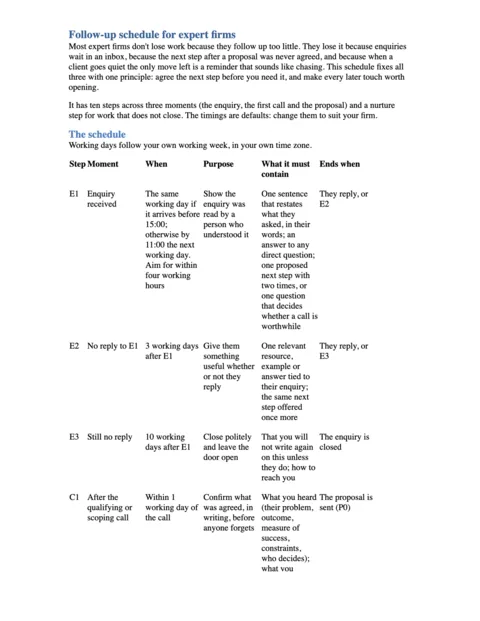
- The next step: when the proposal will arrive, and when you will go through it together.
If two or more are missing, don't send a proposal yet. Book a short call instead.
The seven sections
| # | Section | How long |
|---|---|---|
| 1 | Where you are | 2 to 4 sentences |
| 2 | What you want to achieve | 2 to 3 sentences |
| 3 | What we will do | 3 to 5 sentences |
| 4 | Investment and options | A short table |
| 5 | Timing and who does the work | 2 to 4 sentences |
| 6 | Why us, for this | 2 to 3 sentences |
| 7 | Next step | 2 sentences |
The default fits on one page, with up to three short appendices. If a client needs more, keep the same seven sections and stay under about ten pages. Offer one option you recommend, unless the client asked for a choice.
How to use it
- Open the file and save a copy for each proposal.
- Fill in each section from your call notes, in the client's words.
- Take fees only from your current rate card. Mark anything you can't fill as a gap.
- Before you send it, run the five checks at the end of the file.
The file has a full one-page example. It uses a made-up firm and client.
Where it comes from
- Across 742,137 proposals sent in 2025, the ones that won had 7 sections and 11 pages on average. The ones that lost had 13 pages (Proposify, 2026).
- Proposals sent within a day of the call were 19.1% more likely to win (Better Proposals, 2020).
- The one-page core follows Blair Enns's one-page proposal.
The first two come from vendors' own data. They show a link, not a cause, and they are not just about consulting firms. The file lists each source and its limits.
Using it
You may use, change and share it inside your own firm. Please don't sell it or publish it as your own.