A bid or no-bid decision is the choice you make before anyone writes a word: is this tender or proposal request worth your firm's time? For a consulting, advisory, research or training firm of 8 to 30 people, the answer should take about fifteen minutes. Check seven red flags. If any is true, don't bid. If none is, score five factors and let the total decide: bid, bid only if one named condition is met, or say no politely.
Below I go through each part, score a made-up tender, and then cover the other half of the job: once you have said yes, how to write the proposal in hours rather than days.
Every tender you answer is unpaid work
Every proposal is unpaid work. Tender rules often say so outright. UN Women's instructions to proposers, for example, state that the cost of preparing a proposal "shall be borne by the proposers, regardless of the conduct or outcome of the solicitation process" (UN Women, Instructions to Proposers).
In a firm of twelve people, that unpaid work lands on the same two or three people who also run the client work. Usually that means the founder. So a weak bid costs more than a lost evening. It costs the time you could have spent on a proposal you were likely to win, or on the clients who already pay you.
The large proposal teams know this too. Loopio, which sells proposal software, surveyed more than 1,500 proposal teams for its 2026 benchmark report. It found that 75% use a go/no-go process, and 81% of teams that win more than half their bids use one (Loopio, 2026). That is a vendor survey of formal proposal teams, which average eight people each, not small expert firms. It shows the habit is common among teams that win. It does not prove the habit causes the wins.
The seven red flags that mean no bid
Start with red flags, because they are quick and they overrule everything else. Any one of these answered Yes means the recommendation is no bid, whatever the score. You can still choose to bid. If you do, write down why.
These seven come from the bid-or-no-bid checklist I give away on this site.
- Too little time for the size of the job. The response is due in fewer than five working days and needs more than ten pages, or a presentation.
- No one has spoken to the people who decide. Nobody at your firm has spoken, or can speak before the deadline, to anyone who will make or shape the decision.
- The budget is far too low. The stated budget is 30% or more below what your current rate card gives for this scope.
- It is written for someone else. The requirements name a method, tool or past project that only the current supplier could meet.
- The work keeps coming back. This is the third time this buyer has put this work out without awarding it.
- You can't do most of it yourselves. Delivering it would mean hiring or subcontracting more than half the work, and no partner is agreed.
- The terms are ones you have never accepted. The contract includes unlimited liability, or payment more than 60 days after invoice, and your firm has not accepted that before.
The second flag is the one small firms argue with most. "But it's a public tender, we're not allowed to talk to them." Often you are. Buyers are encouraged to talk to suppliers before a tender goes out. The UK's guidance on its Procurement Act 2023 says the policy aim is "to encourage contracting authorities to speak with the market before commencing a procurement" (GOV.UK, Preliminary Market Engagement, updated 13 July 2026). Once a tender is live, you can still ask written questions. On the UN Global Marketplace, the buyer answers in writing and sends the answer to every supplier at once, without saying who asked (UNGM Help Center). So "no one has spoken to the buyer" usually means "no one has tried".
The people who bid for a living say the same thing in rougher words. In a 2024 thread on r/consulting about government tenders, one reply put it bluntly: "You have no chance if you are first seeing solicitations on a 'sourcing platform.'" Others had already shaped the requirement before it was released (Reddit, r/consulting). And on Hacker News, back in 2009, a small firm owner wrote: "We get on the phone before we respond to expensive RFPs" (Hacker News). That is one forum comment each, not research. But it matches what I saw.
The seventh flag is about cash. A twelve-person firm feels a 90-day payment term hard, so treat new terms as a cost of the bid.
How to score an opportunity: five factors
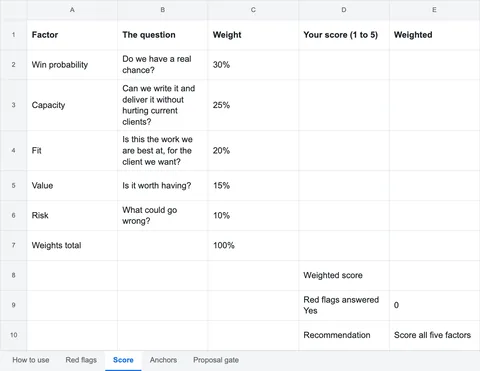
If no red flag is true, score five factors from 1 to 5. Each has a weight, and the weights add up to 100%.
| Factor | The question | Weight |
|---|---|---|
| Win probability | Do we have a real chance? | 30% |
| Capacity | Can we write it and deliver it without hurting current clients? | 25% |
| Fit | Is this the work we are best at, for the client we want? | 20% |
| Value | Is it worth having? | 15% |
| Risk | What could go wrong? | 10% |
Scoring by feel drifts. So pin each score to a plain description. Here is what a 1, a 3 and a 5 look like in the checklist:
| Factor | A 1 looks like | A 3 looks like | A 5 looks like |
|---|---|---|---|
| Win probability | No relationship; open competition; we learned of it from a portal | We know someone there; we have had one useful conversation; a few known competitors | They asked us to bid; we have worked for them or were referred by someone they trust; we helped shape the requirement |
| Capacity | Writing it would take the founder out of client work for more than three days, and delivery would clash with existing work | The writing fits with some evening work; delivery needs one person moved | Writing fits in normal hours and past proposals cover most of it; the delivery team is free on the dates |
| Fit | Outside our core services or sector | Next to what we do; we could do it well with effort | Our core work, in our sector, and it builds the reputation we want |
| Value | Below our usual fee, or the margin is unclear | At our usual fee | Above our usual fee, or likely to lead to repeat work |
| Risk | Unclear scope, hard terms, a client we don't know who has had disputes | Some unclear scope, standard terms | Clear scope, fair terms, a client we know |
Two people scoring the same tender should land within one point on each factor. If they don't, talk about why before you total anything.
Then multiply each score by its weight and add them up.
| Total | What to do |
|---|---|
| 4.00 to 5.00 | Bid. Book the internal review date now |
| 3.50 to 3.99 | Bid only if a named condition is met by a named date. If it isn't, don't bid |
| Below 3.50 | Don't bid. Decline politely, and say what work you would be glad to be asked for |
Where the weights come from, and their limits
The weights are adapted from a model published by SiftHub, a company that sells proposal software (SiftHub, 2026). I gave capacity more weight and fit less. In a small firm, one tender can take the founder out of client work for a week, so capacity matters more than it does for a company with a proposal team.
No study shows that these weights predict wins. Treat them as a starting point. Once a quarter, compare the scores of the tenders you won and lost. If you keep winning the conditional ones and losing the high scorers, change the weights.
A worked example: one tender, scored
This firm and tender are made up.
A 12-person research and training firm finds a request for proposals from a regional development agency. The agency wants a six-month training programme for its field staff. The response is due in 15 working days and needs about twenty pages.
Red flags first. The firm has enough time for twenty pages. One of its partners met the agency's programme lead at a conference last year, so there is someone to call. The budget range in the request sits within the firm's rate card. The requirements don't name a past project or a tool only one supplier could meet. This is the first time the work has been put out. The firm can deliver it with its own people. The terms ask for payment within 30 days. No red flags.
Then the scores.
| Factor | Score | Why | Weighted |
|---|---|---|---|
| Win probability | 3 | One useful conversation, a year ago. Some known competitors | 0.90 |
| Capacity | 4 | Writing fits mostly in normal hours. Delivery needs one person's diary moved in month two | 1.00 |
| Fit | 5 | Core work, core sector, the kind of client they want more of | 1.00 |
| Value | 3 | At their usual fee | 0.45 |
| Risk | 3 | Section 3 of the scope is vague about how many locations are included | 0.30 |
| Total | 3.65 |
A total of 3.65 means bid only if a condition is met. So the firm names one: the partner calls the programme lead by Friday. The call has two aims: to confirm the budget range and to find out how many locations section 3 really covers. They also send that second question in writing through the official channel, so every bidder gets the answer.
What the call changes. Say the programme lead confirms the budget, explains the problem in their own words, and the agency's written reply fixes the locations at four. Win probability moves from 3 to 4, and risk moves from 3 to 4. The new total is 4.05. Now it's a clear bid, and the firm books its review date.
If the partner can't get the call by Friday, the condition fails and the firm doesn't bid. It sends a short, polite note saying so, and what work it would like to be asked for next time.
One call moved the score from conditional to bid. That is what the scoring is for: it made sure the call happened before anyone wrote twenty pages.
Ordinary proposals need a shorter check
Most work at an expert firm doesn't come through tenders. It comes from a referral, a call, and "can you send us something?" Scoring that against five factors is overkill. Use five Yes or No questions instead, before you agree to write:
- Did they describe a problem in their own words, and an outcome they want?
- Do we know who decides, and will they read it?
- Is there a budget range, and does it fit our rate card for this scope?
- Is it work we are good at and want more of?
- Have we agreed when we will go through the proposal together?
Four or five Yes answers: agree a send date. Fewer than four: have one more short talk first. Don't write a longer document to make up for a short conversation.
Agree the price before you write the proposal
The third question is the easiest to skip, and it saves the most time.
If the client first sees your price in the proposal, the proposal has two jobs. It has to describe the work and also win an argument about money, without you in the room. Proposals that do both get long, and long proposals are slow to write and slow to approve.
So talk about the price on the call. You don't need a final figure. A range is enough: "Work like this usually falls between X and Y. Does that fit what you had in mind?" If the answer is no, you have saved yourself a proposal. If it's yes, the proposal confirms what you agreed.
Blair Enns, who runs the sales training firm Win Without Pitching, goes further. He argues that if a proposal needs a lot of work to write, the client should pay for that work: "Any time you have to undertake a lot of work to write a proposal, you should get paid to do that work" (Win Without Pitching, 2025). Not every client will pay for a first step. Even then, do the thinking with the client on a call, before you write the document.
The pipeline template builds this in. A piece of work only moves from "Scope" to "Propose" once you have agreed the problem, the outcome, the budget range and who decides, and the client has agreed to get a proposal on a set date.
Write every opportunity up the same way
In my last business development job, at a Bangkok-based consulting firm that works globally, I set up alerts in the UN's procurement marketplace across 32 categories. That brought in more opportunities than anyone could read properly. What made it workable was a routine. I wrote every opportunity up in the same format, checked each bid against what the buyer had asked for, and decided with the team which ones were worth the firm's time.
The same format matters because it makes opportunities comparable. When every write-up has the same few lines (who the buyer is, what they want, the deadline, the budget, who we know there, and the red flags), a weak one looks weak next to a strong one. When each is a forwarded email with "thoughts?" on top, they all look possible.
Timing matters as much as format. Once I found a tender with two days left before it closed. I asked the buyer for more time, got it, and we submitted a proper proposal. Buyers can extend deadlines. The UN's procurement training tells its staff to give vendors "sufficient time" to respond, and to tell every invited vendor about any extension (UN procurement e-learning, The Solicitation Process). But you should not rely on an extension. The point of the alerts and the same-format write-ups was to find tenders early, so the decision could be made with time to spare.
How to write the proposal faster once you say yes
The checks that make the decision quick also make the writing quick. When you said yes, you had a library to check the bid against, a price range the client accepted and a send date. Use them, and log the hours so the next decision rests on what bids really cost you.
Start from your best past work, never a blank page
The library is the same material that scores your capacity. The anchor for a 5 reads "past proposals cover most of it", and that is only true if you can find them. Pick your five best proposals: the ones that won, or the ones you're proudest of. Put them in one folder with your current case studies, short team profiles and your current rate card. That folder is your library. Every new proposal starts there.
You probably have this material already. It's spread across old emails, a former partner's laptop and three versions of "Proposal_FINAL_v2". The work is gathering it once. After that, writing a proposal means choosing and adapting, not inventing.
Two rules keep a library honest. Take fees only from the current rate card, never from an old proposal. And when a section doesn't fit this client, mark it as a gap for a person to fill. A gap left in the open is better than a paragraph that was true for someone else.
Keep it short and in the same order
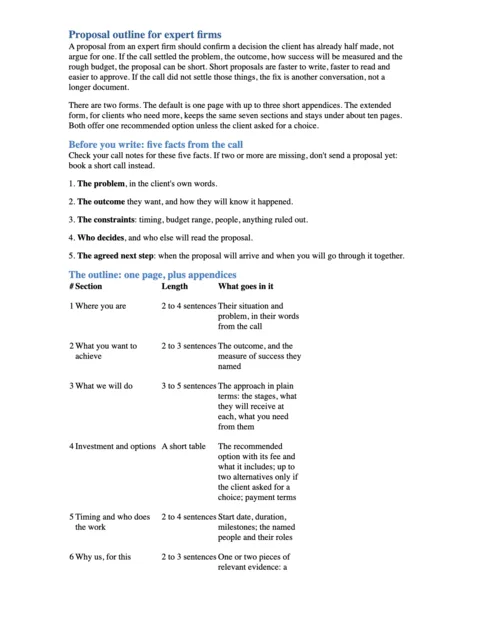
If the price and scope were agreed before you said yes, the proposal confirms them, and it can be short. The proposal outline uses seven sections: where you are, what you want to achieve, what we will do, investment and options, timing and who does the work, why us for this, and the next step. The default fits on one page, with up to three short appendices.
There is some data behind short. Proposify, a proposal software company, looked at 742,137 proposals sent through its platform in 2025. The ones that won averaged 11 pages and 7 sections. The ones that lost averaged 13 pages (Proposify, State of Proposals 2026). That is the vendor's own platform data across 30 industries, not consulting alone. It shows a link, not a cause. Winning proposals may be shorter because the client had already decided.
Send it within two working days
The send date belongs in the decision. Agree it on the call, and aim for two working days. Better Proposals, another software company, reported in 2020 that proposals sent within 24 hours of talking to the client were 19.1% more likely to win (Better Proposals, 2020). Treat that with care. It's dated, it comes from the vendor's own platform, and the report doesn't say how many proposals it counted. A proposal that arrives while the call is fresh is still easier to read and easier to approve.
Track the hours each proposal takes
Write down the founder's or partners' hours on every proposal, and on every tender you decide against. It takes a minute. After a quarter you will know what a bid really costs you, which kinds take longest, and whether the library is paying off. That figure goes straight back into the capacity score on the next tender. Without the log, nobody sees the cost, so it never becomes a reason to say no.
Common mistakes in the bid or no-bid process
- Deciding after you've started writing. Two days of pre-work is not a reason to bid. Judge the work still to come and your chance of winning, not the time already spent.
- Bidding because the diary is empty. A quiet month makes everything look worth it. That is exactly when the red flags matter most.
- Treating "we know someone there" as a relationship. Knowing the procurement officer is not the same as having spoken to the person who decides.
- Scoring alone. One person's scores drift towards what they want. A second scorer within one point is the check.
- Never looking back. If you don't compare scores against wins and losses, the checklist never gets better than the day you started.
- Saying no badly. A no-bid is a message to a buyer you may want later. Say no promptly, thank them, and say what work you would like to be asked for.
Your bid or no-bid checklist for this week
- Download the bid-or-no-bid checklist and run it on the next tender or proposal request that arrives.
- Before your next client call, decide the price range you will mention, and mention it.
- Pick your five best proposals and put them in one folder with your current rate card.
- Open a simple log and write down the hours on your next proposal.
- On your next call where a proposal comes up, agree the date you will send it.
- Put a date in the diary three months from now to compare your scores with your wins and losses.
Frequently asked questions
What is a bid or no-bid decision?
It is the decision, made before any writing starts, on whether a tender or proposal request is worth answering. It weighs your real chance of winning, your capacity, the fit, the value and the risk against the unpaid time a bid takes. Large companies often call it a go/no-go decision.
What criteria should a small firm use for a bid or no-bid decision?
Use red flags first, then a weighted score. The red flags rule out bids you can't win or can't afford to win: too little time, no contact with the people who decide, a budget far below your rates, requirements written for the current supplier, or terms you've never accepted. The score then weighs win probability (30%), capacity (25%), fit (20%), value (15%) and risk (10%).
How long should a bid or no-bid decision take?
About fifteen minutes for the checklist itself. A conditional bid can take a few days longer, because the condition is usually a conversation with the buyer by a set date. If the decision drags on for a week, you have lost writing time on a bid you might still make.
Is it worth bidding on a tender if we have never spoken to the buyer?
Usually not. With no contact at all, you're likely competing against firms that helped shape the requirement. First check whether you can still ask a written question or talk to the programme lead before the deadline. If you can't, treat it as a red flag.
How do you decline a tender politely?
Reply promptly, thank the buyer for including you, and say briefly that you won't be submitting this time. Then name the kind of work you would be glad to be asked for. A clear no that points to the right work gives them a reason to ask you next time.
If you'd like to see where your own firm stands on these habits, the scorecard takes a few minutes. The Diagnostic goes further, on your own records.