The best way to follow up on a proposal is to do most of the work before you send it. While you're still on the call, agree a date to go through the proposal together. After that, make each message add something: an answer, an example, a simpler option. Ask where the decision stands at two weeks. Close the file at thirty days. Then write down why you won or lost.
Below is each step, with example messages, the phrases to drop, and a checklist you can use this week. It's written for founder-led consulting, advisory, research and training firms that win work through referrals and written proposals.
Why I agree follow-up dates in advance
The most useful follow-up I ever did was boring. In my last business development job, a UN framework agreement the firm held was coming up for renewal. I asked about the renewal six months early. The client gave me dates. I followed up on those dates, and it was renewed. There was nothing clever in it.
Everything below works the same way. Follow-up feels awkward when you're guessing what the client expects. It feels normal when both sides agreed it would happen.
Why proposals go quiet
Silence after a proposal is rarely about the proposal. People who have been on the buying side say so plainly. In a 2019 Hacker News thread on prospects who vanish, an engineer who bought for a corporate R&D group listed the usual reasons. The product didn't meet the spec. The budget wasn't approved. The deal got stuck in purchasing after the hand-over. Or the project was cancelled. Another buyer admitted to simply not replying after finding another option, shelving the problem, or hearing no from management.
Most of those reasons are things you can't see from your side. That's why a reminder rarely helps. "Any update?" asks a busy person to explain a decision they haven't made, or don't want to admit to.
It's also why tracking who opened your proposal tells you less than it seems to. In Proposify's 2026 report on 742,137 proposals sent through its platform in 2025, buyers had viewed 80% of the proposals they went on to reject, and 93% of those they signed. (Vendor platform data. "Viewed" means opened, not read.) As one Hacker News commenter put it: "If you don't get any responses, that is a response."
What helps is a next step that both sides agreed to, and later messages that are worth opening.
The follow-up schedule at a glance
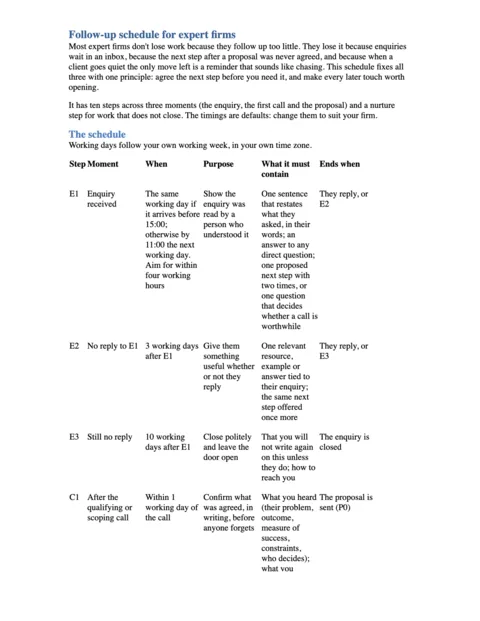
These timings come from the free follow-up schedule. They are defaults. Change them to suit your firm.
| Step | When | What it does |
|---|---|---|
| C1 | Within 1 working day of the call | Puts what you agreed in writing, with the date the proposal will arrive |
| P0 | On the day you agreed | Sends the proposal, with the next step and its date |
| P1 | 2 to 3 working days after P0 | Goes through the proposal together |
| P2 | 7 days after P0 | Helps them decide, without asking for a decision |
| P3 | 14 days after P0 | Asks where the decision stands |
| P4 | 30 days after P0 | Closes the file without pressure |
| N | Every 90 days after close, up to four times | Stays useful to people who may buy later |
Two rules hold it together. When the client replies at any point, stop the schedule and carry on by hand. If they give you a decision date, move P3 and P4 to it.
The examples below use a made-up firm. Larchmere Advisory is a 14-person operations advisory and training firm. Dana Okafor at Fernhill Logistics has asked about training for new warehouse supervisors. The firm, the people and the details are invented.
Step 1: Agree the next step before you send
The most useful follow-up happens on the call itself. Before you hang up, agree two dates: when the proposal will arrive, and when you'll go through it together. Ask who else will decide, and invite them to that second meeting.
This is the step that gets skipped. The call goes well, everyone is friendly, and someone says "send something over". Nobody agrees what happens after it arrives. A week later you're writing a reminder, and it feels like chasing because nothing was agreed.
A Hacker News commenter who sells for a living described the mindset well: half the point of an early conversation is to set up the next one, and "you can't just add 'ok, next steps' at the end". Leave ten minutes at the end of the call for it.
Then send a short summary within one working day. Speed matters here. In Better Proposals' 2020 report, proposals sent within 24 hours of talking to the client were 19.1% more likely to win. (Vendor platform data from about $1.48 billion of proposals won on its platform; the number of proposals isn't stated, and it shows a link, not a cause.) A same-day summary keeps that pace even when the proposal itself takes a few days.
C1, the call summary (made-up example)
Dana, thank you for the time today. Here's what I heard. New supervisors struggle most with shift handovers in their first three months, and you'd count it a success if handover errors fell by the summer peak. Budget sits with you, and your operations director, Sam, will join the decision.
What we agreed: I'll send a proposal by Thursday 6 November. We'll go through it together on Monday 10 November at 10:00, with Sam if possible.
If I've got anything wrong, tell me and I'll fix it before I write.
The summary does two jobs. It shows you listened, and it puts the next step in writing. If you got something wrong, you find out before you write the proposal.
Step 2: Send the proposal on the day you said
Send the proposal on the date you agreed, with a short covering note. Restate the next step in the note. Don't write a long email that repeats the proposal; the proposal does that.
If you didn't manage to agree a walkthrough on the call, use the method Jonathan Stark recommends: promise a date in the covering note, and keep the promise. Stark's line is: "I'll follow up on $specificDate if I haven't heard back before then." When that day comes, you're keeping a promise you made in writing.
P0, the covering note (made-up example)
Dana, as promised, the proposal is attached. It sets out two options for the supervisor programme, with the fees and timings for each.
We're going through it together on Monday at 10:00. If Sam can join, we can cover the questions on measurement.
Talk on Monday.
The proposal outline ends with a "Next step" section for the same reason. The next step should be in the proposal and in the email, so nobody has to go looking for it.
Step 3: Go through it together
A walkthrough is worth more than any reminder. You answer questions while they're fresh. You hear objections you'd never get in an email. And the other people who decide get to see the proposal with you there to explain it.
In Proposify's 2026 report, close rates were about 20% higher when more than one stakeholder viewed the proposal. (Vendor platform data across 30 industries; "viewed" means opened, and it's a link, not a cause.) It fits what I saw in business development: a proposal read by one person, then summarised to a boss, loses something on the way.
If no walkthrough was agreed, send a note two working days after the proposal. Ask one specific question and offer two times.
P1, if no walkthrough was agreed (made-up example)
Dana, a question on the proposal. Option B starts in February so the programme ends before your peak. Does that start date work with your hiring plan?
It may be quicker to go through it together for 20 minutes. Would Tuesday at 14:00 or Wednesday at 10:00 suit? Sam would be very welcome.
Step 4: When the client goes quiet, add something
A week after the proposal, if the decision hasn't come, send something that helps them decide. Don't ask for the decision. Answer a question raised in the walkthrough, share a short example of similar work (with permission, or with names removed), or make an option clearer.
A reminder takes something from the client: their attention, and an answer they don't have yet. A useful note gives them something, even if they never reply.
P2, adding something at day 7 (made-up example)
Dana, on Monday Sam asked how you'd know if handovers were improving before the peak. I've drafted a simple weekly check: three questions each supervisor answers at the end of a shift. It fits into either option without changing the fee. It's attached.
Nothing needed from you. I thought it might help with the budget conversation you mentioned for the 20th.
The note doesn't check in, doesn't ask about the decision and doesn't invent a deadline.
Step 5: Ask where the decision stands
Two weeks after the proposal, it's fair to ask. Keep it to one question about their process or timing. Offer to adjust the scope or the start date if that's the obstacle. And give them an easy way to say no.
The easy way out is the part people leave off. Clients often go quiet because saying no to someone they liked feels awkward. If you make no a normal answer, you get answers.
P3, the decision check at day 14 (made-up example)
Dana, where has the decision got to on the supervisor programme? If the timing or the scope is the obstacle, I can change either: a smaller first group, or a later start.
And if it's a no for now, that's fine. A one-line reply saves us both a follow-up.
If Dana gave you a decision date, send this two working days after that date instead.
Step 6: Close the file, politely
At thirty days, close it. Say you'll assume the timing isn't right, that the proposal stands until its validity date, and how to reopen it. Then stop.
Closing can feel like giving up. In my experience, though, a clean close is often the message that gets a reply, because it takes the pressure off. It also gets a dead opportunity off your list, so your weekly review is about work that can still move.
P4, the close-out at day 30 (made-up example)
Dana, as I haven't heard back since the 20th, I'll assume the timing isn't right and close this on our side. The proposal stands until 31 January if things change.
If a smaller start or a different date would help, reply here and I'll pick it up.
After the close, the schedule has one more step. Every 90 days, up to four times, send something specific to them: an article that fits their problem, an introduction, a short observation, with no pitch. Priorities change, and the firm that stayed useful is the one they remember.
How many times should you follow up on a proposal?
After you send a proposal, four touches is the ceiling: the walkthrough, the useful note, the decision check and the close. The schedule says not to add one between P0 and P4. You can always make a gap shorter.
You'll see confident numbers online for how many follow-ups a sale "needs". The ones I traced had no source behind them. The closest real figure is from RAIN Group's research on sales prospecting: top performers reached a first meeting in about five touches, against eight for everyone else. (Vendor research, self-reported by 489 sellers and 488 buyers across 25 industries; the page gives no year.) That was for cold outreach to new prospects, not a proposal someone asked for. So I use it only as a ceiling. If you need more than four messages after a proposal, the problem is earlier: the next step was never agreed.
Keep every follow-up in one list
Follow-up fails most often because it lives in someone's head. The partner who ran the call knows a note is due on Thursday. Then client work fills Thursday, and nobody else knew.
The fix is one shared list where every open opportunity has three things: an owner, a next step and a date. Write the next step as a verb and an object, such as "Send call summary" or "Walkthrough with Dana and Sam". Sort by date each morning and do what's due. The free pipeline template is a spreadsheet built around that rule, and it flags any next step that is overdue or missing.
Once a week, go through the list together for thirty minutes. The weekly review agenda has one fixed item for proposals and follow-ups: is each one on track, and is anything overdue? No opportunity leaves the meeting without an owner, a next step and a date, or a reason to close it.
You don't need a CRM for this. A spreadsheet that people actually update beats a system nobody opens.
Record why you won or lost
Every closed opportunity should carry a reason. Without one, you can't tell whether you lose on price, on fit or on timing, and you'll keep guessing. The pipeline template gives you a fixed list so everyone uses the same words: price, scope or fit, timing, chose a competitor, chose to do it in-house, no decision, unknown, other.
"Unknown" will be your biggest group at first. That's normal. To shrink it, ask. One Hacker News commenter suggested writing as if the decision is already made, and asking only for a quick reason. People find that much easier to answer than a sales email.
Asking why you lost (made-up example)
Dana, thank you for letting me know you've gone another way. One quick question, if you have a moment: what made the difference? Price, timing, the approach, or something else? A few words is plenty, and it'll help the next proposal I write.
Ask about wins too. "What made you choose us?" often tells you what to keep in the next proposal.
Then look at the reasons once a quarter. If most losses say "timing", look at how you qualify enquiries. If most say "no decision", look at whether you agreed next steps on the call. If most say "price", check whether the proposal made the value clear before the fee.
What not to say
These phrases all ask the client to do something without giving them anything. Each has a better version.
| Don't write | Write instead |
|---|---|
| "Just checking in" | The question you actually need answered, about scope, timing or an option |
| "Just following up on my last email" | "As promised, here's..." when you said you'd write on this date |
| "Any update?" | "Where has the decision got to? If timing is the obstacle, I can change the start date." |
| "Did you get a chance to look at it?" | "Sam asked about measurement on Monday, so I've drafted a weekly check." |
| "I haven't heard back" | Nothing. Send something useful, or close the file |
| "Friendly reminder" or "gentle nudge" | A date you agreed together, restated |
| "Last chance" or an invented deadline | The proposal's real validity date, stated once in the close-out |
| "Sorry to bother you again" | No apology. A useful message doesn't need one |
Two more rules from the schedule. Keep each message to about 120 words, short enough to read on a phone; the call summary is the one exception. And never mention another client, a result or a figure you can't back up.
A this-week checklist
- List every proposal you've sent in the last 30 days that has no decision yet. Put each in one shared list with an owner, a next step and a date.
- Close the ones older than 30 days with a polite close-out note. Record a reason for each, even if it's "unknown".
- For each open proposal, write one useful note, not a reminder. Answer a question they raised, or make an option clearer.
- Before your next call ends, agree two dates: when the proposal arrives, and when you'll go through it together.
- Send the call summary within one working day. Put the agreed dates in it.
- Book a 30-minute weekly review and keep the slot.
- Delete "just checking in" from your vocabulary. Search your sent folder for it and see how often it appears.
Questions founders ask
How long should I wait to follow up on a proposal?
If you agreed a walkthrough, there's nothing to wait for: it's already in the diary, ideally two to three working days after you send. If you didn't, send a short note two working days after the proposal with one specific question and two times to talk. After that, the schedule's defaults are a useful note at day 7, a decision check at day 14 and a close at day 30.
What should a proposal follow-up email say?
One thing from their situation, one useful thing or one clear question, and one next step with a date or two times. Keep it to about 120 words. Leave out "just checking in", apologies and invented deadlines. If you can't think of anything useful to add, the next message should probably be the close-out.
What do I do when a client is not responding after the proposal?
Assume something changed on their side that you can't see: budget, priorities or a new person in the chair. Send one note that helps them decide, then one that asks where things stand and makes "no" an easy answer. If there's still nothing at 30 days, close the file politely and add them to your 90-day list.
Is it pushy to follow up after sending a proposal?
Not if you agreed it. Following up on a date you both set is keeping a promise. It starts to feel pushy when there was no agreed next step, so each message has to invent a reason to exist. Fix that on the call, and the follow-up stops feeling like chasing.
Should I track whether the client opened my proposal?
It does little harm, but don't act on it. In Proposify's 2026 report (vendor platform data), buyers had viewed, meaning opened, 80% of the proposals they later rejected. An open tells you the file reached them, not that they're keen. Your next step should come from what you agreed, not from a notification.
To see where your firm loses work between the first email and the signed proposal, try the free five-minute scorecard, or book a Diagnostic to have it measured from your own records.